Sunday, November 22, 2015
Totally Marvelous November Report

Friday, April 25, 2014
It's a Revolution!
Then all hell broke loose.
I discovered what I had been searching for all my life: I am a story teller - with words, pictures and film. Quickly I enrolled in more classes and became a Media Major. I am about to complete my second semester, in which I'm carrying a load of 22 credit hours. For those who are rusty on their college lingo, a normal college load is 12 to 15 credit hours. So I've been a busy, busy person!
After the semester finishes in 2 weeks, I'll give you a more complete picture, and a lot more to read, images to enjoy, and videos to watch.
It is never too late to go on a new adventure.
Tuesday, April 02, 2013
Sand and Paper
I wanted to build a New Patio Wall using unconventional materials. Cheap materials too.
I staggered the sand bags as I stacked them, using old barbed wire in between the layers to prevent any shifting. The polyethylene bags are strong but will fail under prolonged exposure to our brutal sun. So I had to cover it somehow.

So I settled on using Papercrete.
I shred the paper, soak it overnight in water, mix it with mixing bit attached to an electric drill, add cement, mix again, and use a garden trowel to apply it.


I just throw it at the wall and it sticks! Dries nice and hard.

Upon close inspection, you can see the paper bits.

Papercrete should be quite long lasting in my dry climate.
I only have a few more buckets left to finish the entire wall. Papercrete will take paint which is good because the grayish white is maybe not the most attractive.
Just another adventure on the Double Barrel Ranch. This time an adventure in sand and paper.
Friday, March 29, 2013
Still no rain
Tuesday, January 29, 2013
Tuesday, September 18, 2012
Armadillo and Kudzu
First is the Armadillo, which means “little armored one“ in Spanish. The 9 -Banded Armadillo is the only representative of its family in the US. I used to think it was exclusively found in Texas, but its range is spreading, even found occasionally in southern Illinois.. They have a peculiar leathery skin or shell and the only ones I saw were road kill. These burrowing animals can walk fast but have poor eyesight. When they see a vehicle coming, their instinct is to leap 3 feet (almost a meter) straight up. Unfortunately, this is a poor survival skill on a modern highway.
Next is a plant native to Southeast Asia that we call Kudzu, Pueraria montana. It was brought here for use in erosion control about 100 years ago, and advertised as a quick shade for those porches on sun-baked southern homes. Except this perennial semi-woody vine escaped cultivation and has quickly starved native trees and shrubs of sunlight, killing their hosts. It is also a major headache for utility companies. It climbs poles and twines along overhead wires. Measured at a growing rate of a foot day in optimum conditions, the vines with their big three-part leaves can cover anything in their path in short order: parked vehicles, tractors, shacks, sheds, barns, houses, etc.

I observed it in masses along the Interstate highway. Sort of a green leafy nightmare that Alfred Hitchcock would dream up or Orson Welles would film, but it was real. The only livestock that has proven to successfully control it are herds of goats. It can be cut and baled for livestock, but it is prone to molding and the vines are difficult to modify hay equipment to handle. Just another example of clever humans trying to bend nature without seeing future negative consequences. Thankfully it is still a major problem only in the southeastern US, but as it continues to spread... we may have to give up cow milk and start drinking goat milk in the future.
Friday, August 24, 2012
A Couple Views from June 25, 2012


Summer Trip to Eastern US
Driving I-10 east through southern Arizona and into New Mexico is familiar to me. One passes multiple cattle feed lots and dairies - which you can smell if you don’t happen to see them - before you reach El Paso. There one can easily see the International border and old Mexico.
After 186 miles (300 km) I was able to speed up to 80 miles per hour (128 Km/h) on the Interstate in west Texas. (At home our max speed is 75 MPH, 120 km/h, on the Interstate.) 80 is really flying.
Just east of Pecos, Texas I saw the first Pump Jacks. Motors operate these scattered oil well pumps. An I-beam set on an A-frame dips up and down, often with the "horse head" on the end painted in fanciful ways.
Stopped for dinner at a Texas rest stop that had real grass! The area (after mile 665, km 1070) they named "Stink Creek" also had enormous grasshoppers.
Hit the road again after enjoying my crab salad. Drove through Dallas around 11 PM- midnight and there was a few crazy drunk drivers on the Interstate. It was a Saturday night after all.
Crossed into Louisiana at 1 AM and stopped at the "Welcome Center" to rest about an hour. Couldn't really sleep as the humidity was oppressive and the trees were full of singing tree frogs or bugs or something very loud. 1046 miles, 1683 km, from home. Never saw any of Louisiana in daylight. Husband took Keesha for a long walk around the expansive rest area. She had been slightly anxious for the first couple hours of the trip but eventually settled down and slept. We’d borrowed a nice metal kennel/cage to be her home in the back of our Toyota RAV4 and it worked marvelously. Since husband did none of the driving he graciously did most of the dog walking.
Pre-dawn at 5 AM we crossed the mighty Mississippi River at Vicksburg. Stopped at the Mississippi Welcome Center to enjoy the views of the river and watch the daylight grow. Took a few photos but due to the early hour nothing was open. Weather was clear but incredibly humid. Had reached 1230 miles, 1980 km.
Found the Vicksburg National Military Park a few miles away but the scenic and historic drive through the park was not yet open for the day. We did check out several massive cannons that were used in the US Civil War. Vicksburg was the victim of a terrible siege in 1863. Confederate forces surrendered to Union General - and future President - Grant on July 4, 1863 and was a key to the defeat of the rebellion.
We stopped for breakfast in Clinton, MS (just west of Jackson, the capital of MS) at a Waffle House and I ate grits since I was in the deep south. It tasted, eh, okay, but not terrific.
The cheapest gasoline of our trip was purchased in Meridian, MS, Knoxville TN and Steele, Alabama at $2.99 a gallon. Wow. A full tank for less than $30, what a deal! (It is about $40 for same today.)
The Alabama rest areas were stunningly beautiful. Stately trees, shady wooded picnic areas, spectacular red, pink, and white flowering crepe myrtle shrubs. Too bad it was so darn humid!
I-59 cuts through extreme northwest Georgia so we enjoyed only 21 miles, 33 km, of the Peach State.
Then I drove by the Chattanooga Choo Choo and onto I-75 through eastern Tennessee, in the shadow of the Appalachian Mountains and passing exits to the Great Smoky Mountains National Park.
With my co-pilot checking the "Discount Hotel Coupon" booklet, we managed to find a Super 8 in Knoxville that was pet friendly and had a free continental breakfast. Motels all seem to charge an extra $10 for a dog. My dog is clean and neat but we are penalized for less tidy pooches. What can you do? Arrived at 6 PM. Rather tired but went for dinner to Cracker Barrel where I had a disappointing dinner. But it was food.
After a great breakfast, we left at 7 AM. We soon advanced onto I-81 which took us into Virginia, where we stayed for 325 miles, 523 km. Stopped for lunch in Lexington which is the home of Washington & Lee University, the Virginia Military Institute and the Virginia Horse Center. The last is a foundation dedicated to horse recreation, education, and preservation programs. They have dozens of riding arenas, barns with permanent stalls for 750 horses and camping facilities. Oh boy, I want to go back! We had a Thick Burger at the Lexington Hardee's for only $4 and it was delicious. The Appalachian Ridge and Valley region of Virginia was beautiful. "Oh Shenandoah, I long to see you!" Great horse country.
As the day was moving on, we crossed into West Virginia and enjoyed a jam-packed but beautifully landscaped Welcome Center. Took flower pictures, especially of nice Black-Eyed Susan's.
After only 25 miles, 40 km, we left WV, crossed the mighty Potomac River, and passed by Hagerstown, Maryland. Suddenly, in 12 miles, 19 km, we slipped into the Keystone State of Pennsylvania. This was the eleventh state since leaving home.
About 20 miles, 32 km, onward, we stopped in Scotland, PA to explore the tranquil Scotland School for Veterans Children. This residential school was established in 1895 and husband's mother spent a few years there in the late nineteen-teens or early 1920‘s, but he had never seen it. No longer a school, it currently is owned by the state of PA but is being sold to a private religious organization of some type according to the security guard we met. He also blocked our ability to get closer to the solid brick cottages where the students lived but we did look through a few windows of classroom and original old administration buildings. Took many photos for him and his family.
We were still over 150 miles, 240 km, from husband's brother's home and since we didn't want to arrive really late we hurried north again.
A traffic choking accident ahead in Harrisburg caused me to divert my route up the west side of the Susquehanna River. Paused at McKees Half Falls on Rt 15 and 11, a small flower-strewn riverside rest area. The wide river rolling by. But most pleasant of all - the temperature was cool, the humidity much lower. So, so nice.
Arrived at his brother's home in Litchfield PA at 9:30, Monday night June 25. It was nearly dark outside! Husband was shocked at how tall the spruce trees were in front of the house. I warned him that it would look different. Trees don't stop growing because we don't see them for years.
Well, we were all 3 glad to arrive safe and sound. Total 2450 miles, 3942 km. The fun continued...
Wednesday, July 25, 2012
Update
Thursday, June 21, 2012
Leaving on Vacation
Thursday, May 31, 2012
New Mexico Wildfire
Thursday, April 12, 2012
Poppies of Spring

Spring is wonderful here. Summer, eh, not so much. (I am not a heat lover...)

Wednesday, February 29, 2012
Poster for "An Arizona Cowboy"

As seen on a building in
Trail Dust Town,
Tucson, Arizona.
Local color.
Ha ha!
Sunday, January 08, 2012
Colorful Christmas Culinary Creations
Pasta Salad
Potato Salad
Mmm!
Monday, December 19, 2011
Double Rainbow

Just one of several double rainbows that can be seen from the Double Barrel Ranch every year.
Taken at 2:30 PM,
18 December 2011
Wednesday, December 14, 2011

Thursday, December 08, 2011
Cotton Growing
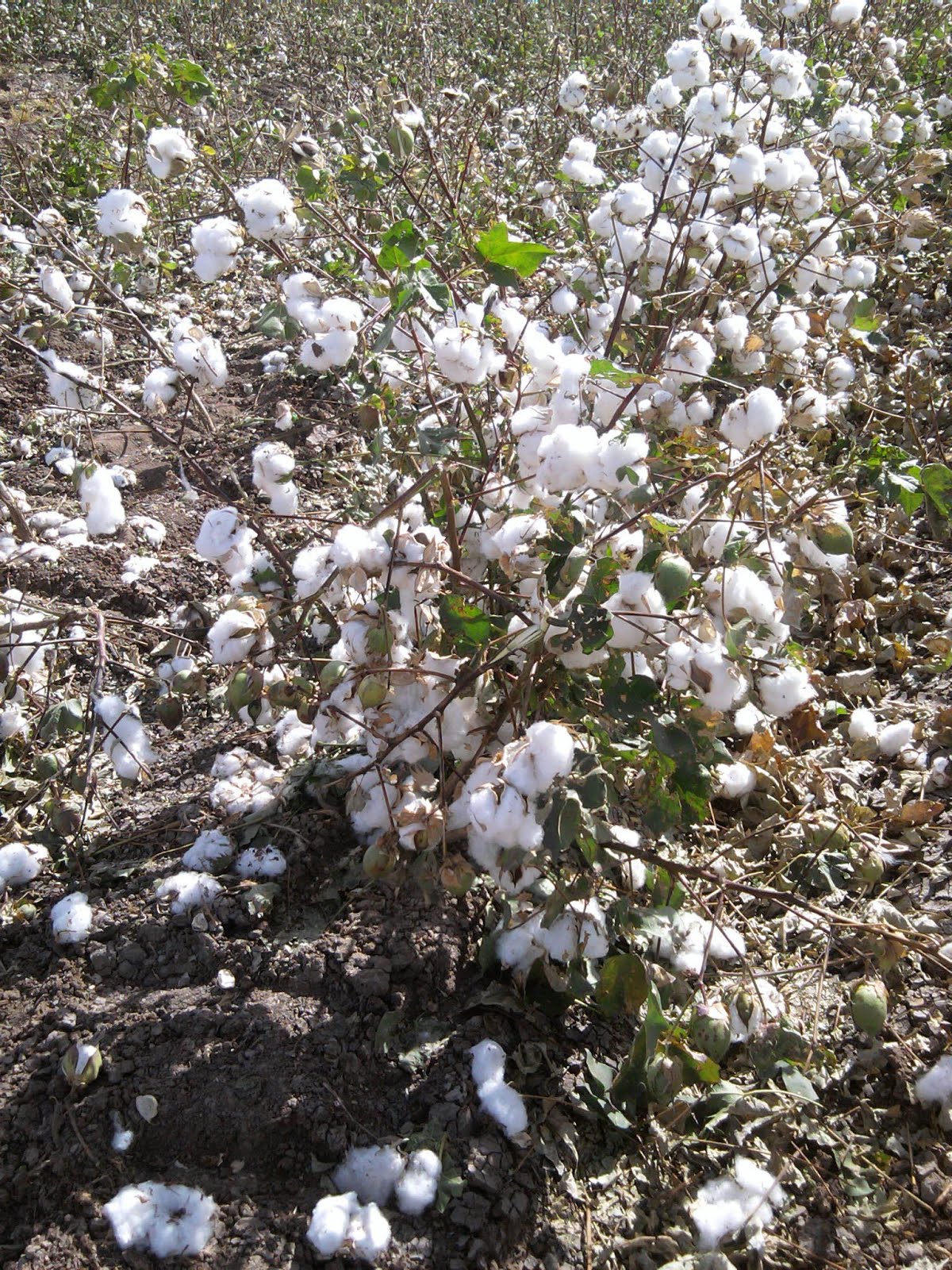
Cotton is “the fabric of our lives” as the advertisement tells us. But in my area it is a huge economic engine too. Many farmers here plant acre after acre of it, all irrigated by wells or ditches (canals or concrete-lined troughs carrying river water) because cotton is a relatively thirsty crop in our desert environment.
The majority of cotton seed is genetically modified, or GM. This makes the plant resistant to insects and herbicides. The cotton boll is the round seed capsule. It used to be a smorgasbord for boll weevils and boll worms but no longer. Although GM cotton is successfully grown today with less manpower and less expense, many see farmers depending upon seed companies for pricey fresh GM seed every year as unfortunate. Also the GM plants can genetically contaminate wild or organic cotton. The GM versus non-modified seed is a subject for a later date.
In the Fall a defoliant is applied to the fields, sometimes by airplane. On still mornings I have been surprised to see the planes flying so low, delivering death to the cotton leaves.
Next the cotton harvester picks the cotton and using air blows it into a basket to the rear. Clouds of dust are created by this since our weather is usually bone dry. I’d not want to live in a house downwind of a cotton field during picking. The harvester dumps the basket into a module builder which compresses it. The 10 ton modules sit under colorful tarps on the edges of the bare fields. Eventually a large truck called a Module Getter, well, gets it, and transports it to the Gin. It is at this point that even the casual observer in my valley will see bits of cotton dancing on roadsides, sometimes drifting. With a twinkle in my eye, I call it our valley “snow.”
As a youngster I learned Eli Whitney invented the Cotton Gin in 1793. I had no idea why this was important or what was a Gin anyway? Actually it is short for “engine.”
But back to the story.
The Module Getter (seen here) is unloaded by an apparatus that sucks the cotton into the Gin where amazing machines separate the seed and the trash from the fiber. The fiber is cleaned and built into white 500 pound bales. The valuable seed is crushed for the edible oil which is used in a variety of foods. The hulls and meal are used for animal feed, but only for ruminants such as cattle, goats, sheep, etc. - no horses or pigs due to a toxic ingredient. One can often see a herd of cows turned out in the winter in a harvested cotton field, eating up the cotton stragglers.
Line of Modules
In spring the irrigation starts again after the fields are leveled by laser. And the farmers have worked at their desks figuring the costs of labor, diesel fuel, water, seed, ginning, etc. versus the expected return which will vary depending on the quality of the cotton and the market price.
Recent market prices vary from $1 to $3 a pound. Oh, can't forget the friendly US Federal government is also there with a hand out cotton subsidy check.
It is a very different cotton world than in Eli Whitney’s day. But then one can buy a pair of cotton denim jeans for the equivalent of 2 hours work at the minimum wage. God bless the American soil and our farmers.
Saturday, May 28, 2011
Death of a Cactus
Due to the march of time, natural forces, I am sad to report that the taller of my two Barrel Cactus pictured on the title page of my blog is gradually dying. It started as a small hole on the side. Then I began to smell the unmistakable odor of death. I thought it might be an unfortunate Jackrabbit or bird. But day after day it got stronger. Finally I noticed the cactus was weeping black sooty crud, with worms in it. Yuck. Today it is leaning precipitously, a wide black gash in its side with putrefaction proceeding rapidly. It is not a pretty sight.
I will keep my photo of the Double Barrels in their prime here, until I get a new picture of a couple others growing together. Barrels seem to like company.
I know one Barrel who will have to go on alone ...
Friday, April 29, 2011
Horses Best Part of Royal Wedding
Somehow I woke up at 3:00 this morning and turned on the TV to see what I could of the Royal Wedding of Prince William and Kate. I never expected to see the best part!
The newly hitched couple proceeded down the red carpet and out of Westminster Abbey and into the ornate open carriage. Below is a postcard picture I have showing William's parents, Charles and Diana, in the same carriage in 1981.

Four grey horses pulled their carriage but there were dozens of shiny black horses being ridden by the Household Cavalry in procession too. They rode at a lively trot. Then my bleary eyes perceived a riderless horse flashing by. What?

Evidently the new Duchess of Cambridge was startled by the loose horse galloping by her and worried about this flaw in her perfect day, but the new Duke reassured her. She must not have any experience with horses. I even heard that Kate has an allergy to horses. What? A Royal without a horse?
This would be as outrageous as our President having an allergy to teleprompters. But come to think of it, that wouldn't be such a bad thing for us.
Oh, the unscathed horse made its way home to its stable without any assistance. The embarrassed rider was okay too but he will surely never live down this incident.
The sharp-eyed reporters covering the event were totally silent about the wayward horse incident. I began to doubt it was real, until this evening I watched a TV show recapping the major parts of the ridiculously expensive wedding day. Again I saw the riderless horse, and yet again the reporters remained mum.
To me, the horses are the best part! Well, I guess everyone has their priorities!
Wednesday, March 23, 2011
Deported?
(I don't often make political statements in my blog. But I do live in Arizona. And recently this state has become central in the illegal immigration debate. A current event sparked my post today.)
Immigration in the US and other countries is a thorny issue. Recently a touching story made headlines when a 4 year old girl was sent to Guatemala where she has relatives, despite “Emily” being a US citizen. Her parents, who live in Brentwood on Long Island, are not legal immigrants. She and her grandfather were intercepted by authorities in a Washington DC airport on their way back home to NY after a vacation trip to Guatemala. The grandfather’s immigration papers had an irregularity and he was detained.
According to the NY Daily News: “Emily could be held at a juvenile facility in Virginia or return to Guatemala with her grandfather. Worried she would be put up for adoption, (the father) chose the latter option and has been trying to get her back ever since. A Customs and Border Protection spokesman confirmed Emily was sent back but would not comment on her case further.
He said agents are instructed to tell parents in similar cases they can pick up their child, have the child turned over to child protective services, or have the kid sent back to the country they left. "We take every effort to reunite minors with their parents," said Steve Sapp. "The parents need to make the decision." But he conceded undocumented parents like Emily's risk being detained if they show up. "They do have to face consequences," he said.”
The media has been playing this up with big headlines saying that the child was deported. But you can’t be deported from your own country. It seems obvious that the parents and the grandfather took the responsibility of sending this child to Guatemala. It is perfectly legal for anyone in America to send their child to live outside the US. It happens every day. Usually a parent is with them though.
The two choices here seem to be: find a legal guardian in the US for the child, or one or both parents should move back to Guatemala. One response I received about her legal guardians is that she has two parents who are her legal guardians. Yes, they are. In Guatemala. But they do not have legal permission to live in the US.
An analogy would be to imagine a university in Rock Lick, West Virginia. One day a couple people come and sit in a professor’s class. They listen and take notes. But their names are not on the class roster. At the end of the semester they demand to receive a grade and credit for the class. After all, they had done the work, didn’t they? So the professor explains that they did not apply to be admitted to the university, did not pass the admissions test, did not pay tuition and fees, so they would not be getting credit. The two students protest. It was not fair. Maybe the professor was prejudiced because he was a West Virginian and they were from Pennsylvania. -Huh?
I realize immigration is more complicated than my classroom crasher example. It is full of unequal economic opportunity factors, family tie issues, language barriers, and history. Not to mention the citizen minor child of non-legal entrant parents, or children who have been residents of the US since they were a babe in arms and know no other culture or country. The answer is not going to satisfy all Americans or all immigrants, legal or otherwise. But the answer should not be blanket forgiveness for every person who has broken US law.
I am not an expert at these tangled knots. I am only a citizen who sees increasing lawlessness and inequitable costs infuriating my fellow Arizonans at the same time it unfairly stains the character of Latinos and others.
People who are living in the US without legal documents ought not be demanding. Like those two students who did not follow the rules, they cannot expect credit for their work, no matter how much they insist. If you lay a poor foundation, you only have yourself to blame when your building washes away or your child is sent to Guatemala.