


Spring is wonderful here. Summer, eh, not so much. (I am not a heat lover...)


Pasta Salad
Potato Salad
Mmm!

Taken at 2:30 PM,
18 December 2011
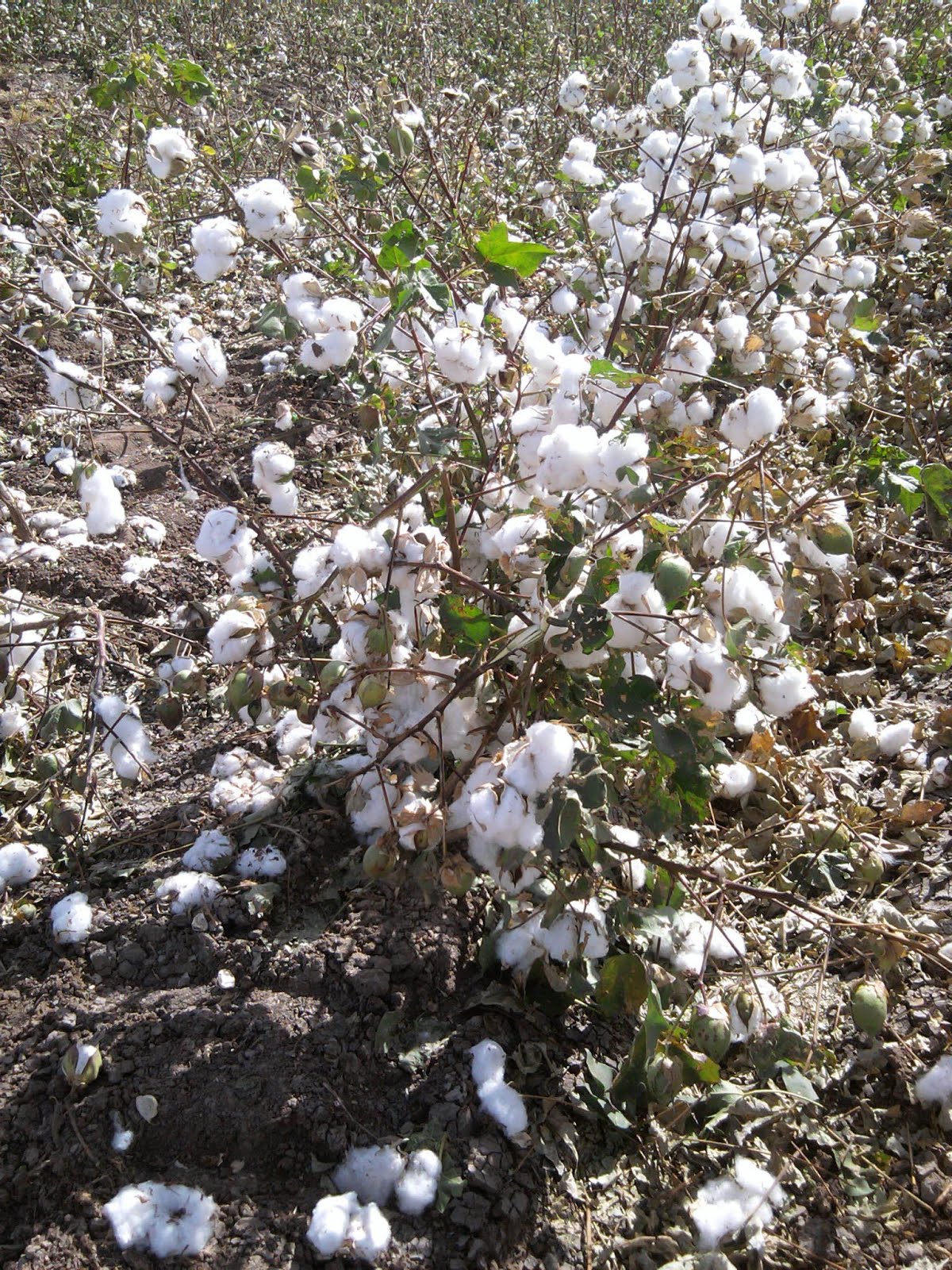
The majority of cotton seed is genetically modified, or GM. This makes the plant resistant to insects and herbicides. The cotton boll is the round seed capsule. It used to be a smorgasbord for boll weevils and boll worms but no longer. Although GM cotton is successfully grown today with less manpower and less expense, many see farmers depending upon seed companies for pricey fresh GM seed every year as unfortunate. Also the GM plants can genetically contaminate wild or organic cotton. The GM versus non-modified seed is a subject for a later date.
In the Fall a defoliant is applied to the fields, sometimes by airplane. On still mornings I have been surprised to see the planes flying so low, delivering death to the cotton leaves.
Next the cotton harvester picks the cotton and using air blows it into a basket to the rear. Clouds of dust are created by this since our weather is usually bone dry. I’d not want to live in a house downwind of a cotton field during picking. The harvester dumps the basket into a module builder which compresses it. The 10 ton modules sit under colorful tarps on the edges of the bare fields. Eventually a large truck called a Module Getter, well, gets it, and transports it to the Gin. It is at this point that even the casual observer in my valley will see bits of cotton dancing on roadsides, sometimes drifting. With a twinkle in my eye, I call it our valley “snow.”
As a youngster I learned Eli Whitney invented the Cotton Gin in 1793. I had no idea why this was important or what was a Gin anyway? Actually it is short for “engine.”
But back to the story.
The Module Getter (seen here) is unloaded by an apparatus that sucks the cotton into the Gin where amazing machines separate the seed and the trash from the fiber. The fiber is cleaned and built into white 500 pound bales. The valuable seed is crushed for the edible oil which is used in a variety of foods. The hulls and meal are used for animal feed, but only for ruminants such as cattle, goats, sheep, etc. - no horses or pigs due to a toxic ingredient. One can often see a herd of cows turned out in the winter in a harvested cotton field, eating up the cotton stragglers.
Line of Modules
In spring the irrigation starts again after the fields are leveled by laser. And the farmers have worked at their desks figuring the costs of labor, diesel fuel, water, seed, ginning, etc. versus the expected return which will vary depending on the quality of the cotton and the market price.
Recent market prices vary from $1 to $3 a pound. Oh, can't forget the friendly US Federal government is also there with a hand out cotton subsidy check.
It is a very different cotton world than in Eli Whitney’s day. But then one can buy a pair of cotton denim jeans for the equivalent of 2 hours work at the minimum wage. God bless the American soil and our farmers.
Due to the march of time, natural forces, I am sad to report that the taller of my two Barrel Cactus pictured on the title page of my blog is gradually dying. It started as a small hole on the side. Then I began to smell the unmistakable odor of death. I thought it might be an unfortunate Jackrabbit or bird. But day after day it got stronger. Finally I noticed the cactus was weeping black sooty crud, with worms in it. Yuck. Today it is leaning precipitously, a wide black gash in its side with putrefaction proceeding rapidly. It is not a pretty sight.
I will keep my photo of the Double Barrels in their prime here, until I get a new picture of a couple others growing together. Barrels seem to like company.
I know one Barrel who will have to go on alone ...
Somehow I woke up at 3:00 this morning and turned on the TV to see what I could of the Royal Wedding of Prince William and Kate. I never expected to see the best part!
The newly hitched couple proceeded down the red carpet and out of Westminster Abbey and into the ornate open carriage. Below is a postcard picture I have showing William's parents, Charles and Diana, in the same carriage in 1981.

Four grey horses pulled their carriage but there were dozens of shiny black horses being ridden by the Household Cavalry in procession too. They rode at a lively trot. Then my bleary eyes perceived a riderless horse flashing by. What?

Evidently the new Duchess of Cambridge was startled by the loose horse galloping by her and worried about this flaw in her perfect day, but the new Duke reassured her. She must not have any experience with horses. I even heard that Kate has an allergy to horses. What? A Royal without a horse?
This would be as outrageous as our President having an allergy to teleprompters. But come to think of it, that wouldn't be such a bad thing for us.
Oh, the unscathed horse made its way home to its stable without any assistance. The embarrassed rider was okay too but he will surely never live down this incident.
The sharp-eyed reporters covering the event were totally silent about the wayward horse incident. I began to doubt it was real, until this evening I watched a TV show recapping the major parts of the ridiculously expensive wedding day. Again I saw the riderless horse, and yet again the reporters remained mum.
To me, the horses are the best part! Well, I guess everyone has their priorities!
(I don't often make political statements in my blog. But I do live in Arizona. And recently this state has become central in the illegal immigration debate. A current event sparked my post today.)
Immigration in the US and other countries is a thorny issue. Recently a touching story made headlines when a 4 year old girl was sent to Guatemala where she has relatives, despite “Emily” being a US citizen. Her parents, who live in Brentwood on Long Island, are not legal immigrants. She and her grandfather were intercepted by authorities in a Washington DC airport on their way back home to NY after a vacation trip to Guatemala. The grandfather’s immigration papers had an irregularity and he was detained.
According to the NY Daily News: “Emily could be held at a juvenile facility in Virginia or return to Guatemala with her grandfather. Worried she would be put up for adoption, (the father) chose the latter option and has been trying to get her back ever since. A Customs and Border Protection spokesman confirmed Emily was sent back but would not comment on her case further.
He said agents are instructed to tell parents in similar cases they can pick up their child, have the child turned over to child protective services, or have the kid sent back to the country they left. "We take every effort to reunite minors with their parents," said Steve Sapp. "The parents need to make the decision." But he conceded undocumented parents like Emily's risk being detained if they show up. "They do have to face consequences," he said.”
The media has been playing this up with big headlines saying that the child was deported. But you can’t be deported from your own country. It seems obvious that the parents and the grandfather took the responsibility of sending this child to Guatemala. It is perfectly legal for anyone in America to send their child to live outside the US. It happens every day. Usually a parent is with them though.
The two choices here seem to be: find a legal guardian in the US for the child, or one or both parents should move back to Guatemala. One response I received about her legal guardians is that she has two parents who are her legal guardians. Yes, they are. In Guatemala. But they do not have legal permission to live in the US.
An analogy would be to imagine a university in Rock Lick, West Virginia. One day a couple people come and sit in a professor’s class. They listen and take notes. But their names are not on the class roster. At the end of the semester they demand to receive a grade and credit for the class. After all, they had done the work, didn’t they? So the professor explains that they did not apply to be admitted to the university, did not pass the admissions test, did not pay tuition and fees, so they would not be getting credit. The two students protest. It was not fair. Maybe the professor was prejudiced because he was a West Virginian and they were from Pennsylvania. -Huh?
I realize immigration is more complicated than my classroom crasher example. It is full of unequal economic opportunity factors, family tie issues, language barriers, and history. Not to mention the citizen minor child of non-legal entrant parents, or children who have been residents of the US since they were a babe in arms and know no other culture or country. The answer is not going to satisfy all Americans or all immigrants, legal or otherwise. But the answer should not be blanket forgiveness for every person who has broken US law.
I am not an expert at these tangled knots. I am only a citizen who sees increasing lawlessness and inequitable costs infuriating my fellow Arizonans at the same time it unfairly stains the character of Latinos and others.
People who are living in the US without legal documents ought not be demanding. Like those two students who did not follow the rules, they cannot expect credit for their work, no matter how much they insist. If you lay a poor foundation, you only have yourself to blame when your building washes away or your child is sent to Guatemala.

The Apache Indian people called the area of Chiricahua National Monument the Land of the Standing Up Rocks. The experts say these pinnacles, spires, and balanced rocks had their origin as volcanic ash spewed from the Turkey Creek Volcano 27 million years ago. The melted ash formed a gray rock called Ryolite. Eventually ice, wind and water have sculpted the formations we see today. Whatever the science is, it is a delight to visit as we three did on January 27. Unfortunately dogs were not allowed on the trails we walked, but Keesha behaved admirably as a guardian at our truck camper.
The dead end road into the Monument begins at the grassland elevation of 5124 feet or 1562 meters. About 2 miles or 3 km beyond the entrance is the Visitor Center where a short film is shown, displays are exhibited and books and t-shirts are sold. This was the Oak-Juniper tree elevation.
We drove up Bonita Canyon and observed the amazing formations which practically grew straight up from the road. The elevation continued to increase until we stopped at Echo Canyon to go on a short hike. A cold wind blew in this exposed spot at 6780 feet or 2066 m, but we bundled up and strolled down the trail to snap photos and eventually reach the Echo Canyon Grotto. The grotto is a large site, a natural jumble of huge Ryolite boulders forming a playful spot for people. We had the place to ourselves on this raw winter weekday. The wind howled through there, a natural air-conditioning which was not needed
 on a day that had us navigating on packed snow on shady parts of the trail. But it was still a delightful place.
Snow on a section of the Echo canyon trail:
After lunch in the camper and hot coffee to warm up, we continued to the end of the road at Massai Point. Not named after an African tribe - those are the Maasai- Massai was an Apache Scout who worked for the US Cavalry in the days of the Indian Wars.
A short but scenic and educational nature trail at this highest elevation point (6870 ft, 2094 m) explains more details about this wild land. The vast majority of the Monument since 1976 is designated as Wilderness Area, which is protected by federal law for non-motorized recreation such as backpacking and horseback riding. The law prohibits logging, roads, and mechanized vehicles including bicycles.
The only place to spend the night in the Monument is in the Bonita Canyon campground. So hikers on the Heart of the Rocks trail, which is 9.5 miles or 15.4 km long, are expected to be out by the end of the day, but it is really the best and most scenic trip among the rocks. I’d love to do it someday.
We backtracked down to the Visitors Center where I bought a bunch of postcards for my postcard swapping hobby.
Then our last stop in the Park before heading home was the 1888 homestead of the Swedish immigrant Erickson family. It was a working cattle ranch, then a Guest Ranch. It is named The Faraway Ranch:
 Finally it was sold per the family’s wishes to the National Park Service in 1979. The home itself has many original antique furnishings and the tour by a helpful volunteer gave us a real taste of what such a frontier life must have been like.
Sadly we packed up and headed for home, a mere 75 miles or 120 km distant, believing we’d arrive before nightfall. Unfortunately an old front right tire decided to come apart and we had to pull over and change it. Things were progressing as well as could be expected until we had to hoist the tire onto the lugs. Fortunately a young man stopped right at the crucial time and he helped us finish the dirty job. At least it was still light out. But the road, Arizona 186, was practically deserted. In the 30 to 45 minutes we were there, only 4 vehicles passed by us. That’s life in the boonies! Yet we still had help. Contrast that to a more populated area where 100 vehicles might go by and nobody stops to aid a motorist.
So we hit the road again, hoping that was the only and the last hiccup. As we drove through the tiny, mostly abandoned town of Dos Cabezas, a herd of mule deer doe crossed the road. Four passed in front of us, and four waited for their turn to cross after we passed. Dos Cabezas isn’t a ghost town - it has resident deer!
We got home later than expected, but in one piece and with a lot of fond memories.
Me in The Grotto:

On sunny but cool January 26th, my husband, our dog Keesha, and I drove south for a couple days of recreation in the Chiricahua Mountains. We traveled Interstate 10 east for 27 miles (43 km) and exited at San Simon. This small farm community of less than 1000 is the last population center before reaching the New Mexico state line. Then we headed south on the Paradise Road, which crosses fairly barren terrain held by the state and the federal BLM (Bureau of Land Management.) It is scrubland with some Mesquite trees.
Eventually the land rises in elevation. Evidences remote residences are seen: mailboxes. About 24 miles (38 km) from San Simon, Paradise is reached. The most remarkable thing about this lovely village was the two doe deer we saw laying in a side yard. In plain view. Just resting in the speckled shade. Maybe they thought we couldn’t see them?
A deer in Paradise -
 Beyond Paradise, we drove up higher and higher into the forested mountains. The road turned snow covered in the shaded northern exposures. We passed a large road grader machine plowing snow. After we crossed the Onion Saddle at 7600 feet (2300 meters) above sea level, the road headed downhill in Pinery Canyon.
Pinery Canyon Road:
Beyond Paradise, we drove up higher and higher into the forested mountains. The road turned snow covered in the shaded northern exposures. We passed a large road grader machine plowing snow. After we crossed the Onion Saddle at 7600 feet (2300 meters) above sea level, the road headed downhill in Pinery Canyon.
Pinery Canyon Road:
 From the truck I glimpsed a Coues Whitetail buck deer with a trophy rack of antlers. He was still carrying this obvious symbol of his sex even though the mating season has passed.
When we got down to 5740 ft (1750 meters) there were several primitive campsites on each side of the road, so we picked a scenic spot under Oak and Juniper trees to spend the night. After setting up, we went for a hike uphill to enjoy the warm sunshine. See photo.
 Later I got out my handgun and shot a few rounds to practice. Then we gathered firewood and I cooked supper, a venison stew over rice.
The campfire was delightful, both for its warmth and the unmistakable sweet scent of Juniper wood. We sat in the night and enjoyed the dancing flames. Keesha charmingly dragged sticks of firewood aside to make a pile of “her” sticks. The stars showed ferociously intense. We were so very far from any artificial light. It was beautiful.
Went to sleep in the camper to the sound of absolutely nothing. Incredible quiet. Even the heater made no noise.
That little fan-less heater kept the camper quite warm. Morning temperature was 25°F (-4°C) when I took the dog for a walk at dawn. Not one vehicle had passed our campsite for nearly 16 hours. Did the world end and nobody told us? Soon we packed up and headed down the road for the Chiricahua National Monument. That is the subject of my next post.
There are probably a hundred more important subjects to write about today, but I am compelled to share these thoughts.
I am an unabashed believer in representative democracy. It is not perfect. No system run by mere men will ever be without blemish. There are aspects to other forms of government that are attractive. Perhaps they work well in other countries. But the US is a unique culture. Socialism has admirers but I can’t see it being viable in the land of Washington and Jefferson and Lincoln.
On a vastly different note, there is an erectile dysfunction drug called Cialis. In case you had not noticed, the word “cialis” is buried within the word “socialism.”
Thanks to a man named Chip I now have this thought -
“Cialis and Socialism: both propping up a good time by artificial means.”
I warned you this posting was not going to be very important!


Actually, the weather grew cooler, days grew shorter. Horses grew their hair longer. African Aloe and Cassia bushes began to bloom about 10 weeks too early. (Due to unseasonable warmth.) Palo Verde trees got pruned because visitors had to duck to reach the front door. Even now visitors over 6 feet (1.82 meters) must watch their scalps. I like the “bower” or arboreal shelter effect.
A pack rat nest located along the driveway was dismantled and burned. The residents having been foreclosed on, or moved away for greener pastures. The summer overgrowth of vegetation totally dried out and since no rain fell for 11 weeks, it stood in brown skeletons, shin high. See photo above.
An impressive new 4 line clothesline was built beyond the pool fence. It is a longer walk to hang the laundry; however, the wood-burning stove smoke won’t be able to “scent” the clothes.
The vegetable garden was inoculated with manure. Wonder where that came from?
Deer hunting, as well as the Black Bear pursuit came up empty. It looks like the spare freezer will be empty soon and can be decommissioned. Although the husband unit has returned to the mountain for the January archery deer hunt, so there is still hope for fresh venison. The Double Barrel Ranch prefers wild game due to the purity and leanness of the meat.
And so a new year begins. And with a very fun numerical date: 1-1-11.

After many days of angling around to get a good clean killing shot with an arrow, my bow hunting spouse finally crept within 50 yards (45 meters) of the small but beautiful buck. He vaguely heard a pick-up truck slow and stop behind him. Suddenly a bullet whizzed by his head, and he saw his buck fall. The shooter, who could clearly see my hunter and his prey, very recklessly, illegally and ungentlemanly had fired from the road. My husband unit was terribly shook up but the unsporting and rude young man basically said: “Tough Luck!” He picked up the deer, tossed it in his truck and sped away without even tagging it. (Attaching the permit to the dead animal to prove a legal taking.) Due to disability (my man often bow hunts with one crutch), he was not able to make his way down the snow covered slope to the road to record the rude offenders vehicle license number.
To add insult to injury, the Sheriff arrived a short time later to inform him that the mountain was being evacuated due to the snow storm. Swift Trail, US 366, is a steep, narrow road of extreme twists and turns. The 6 or 8 inches (15 to 20 cm) of snow at this elevation was becoming dangerous, not to mention what might have been accumulating 2000 to 3000 feet (600 to 900 meters) above.
So his December hunt was over.
The boorish road hunter who could have easily put his bullet into my husband unit was undoubtedly boasting about his great stalking skill to his goon friends. We hope he chokes on the venison

